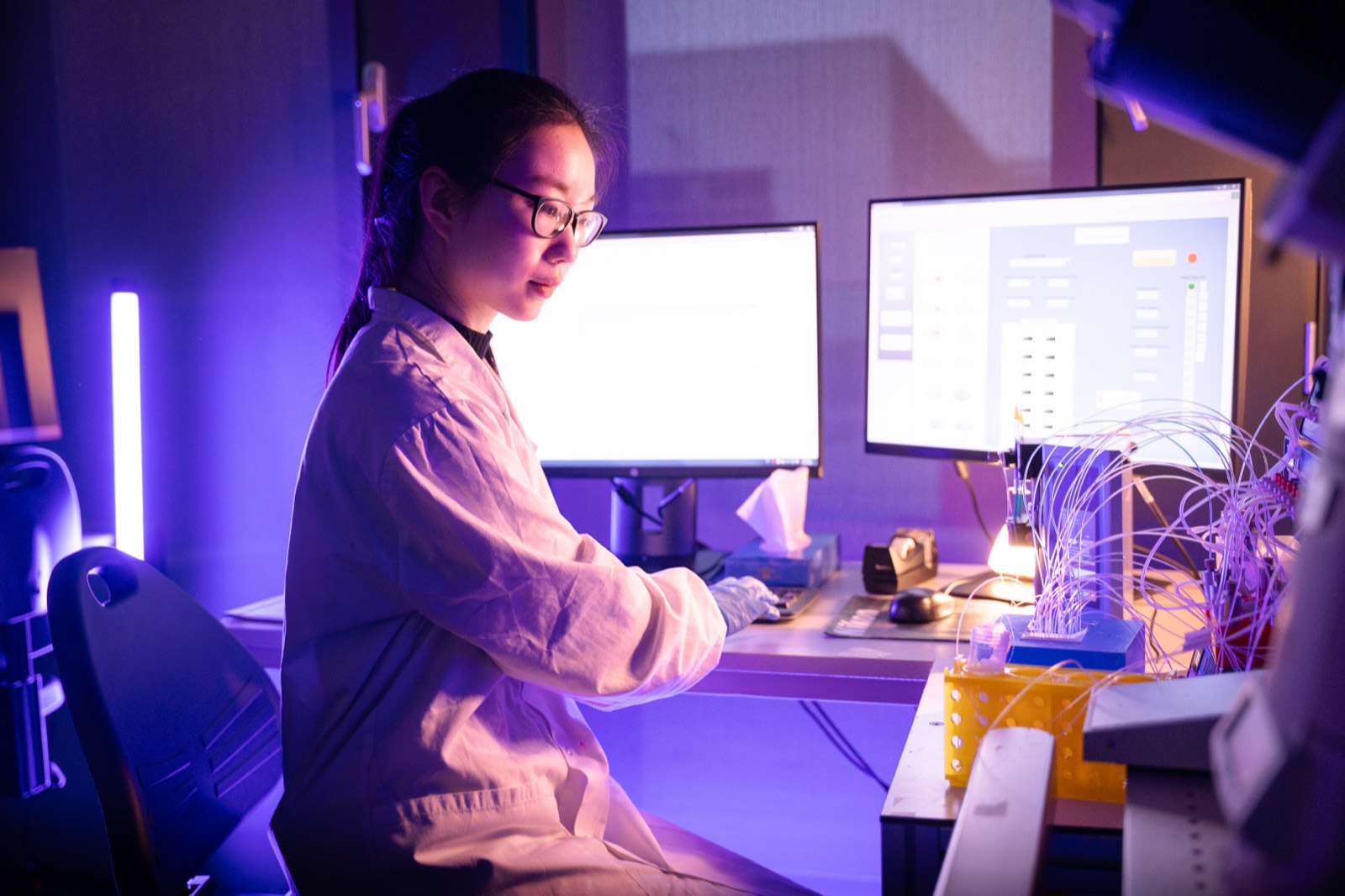
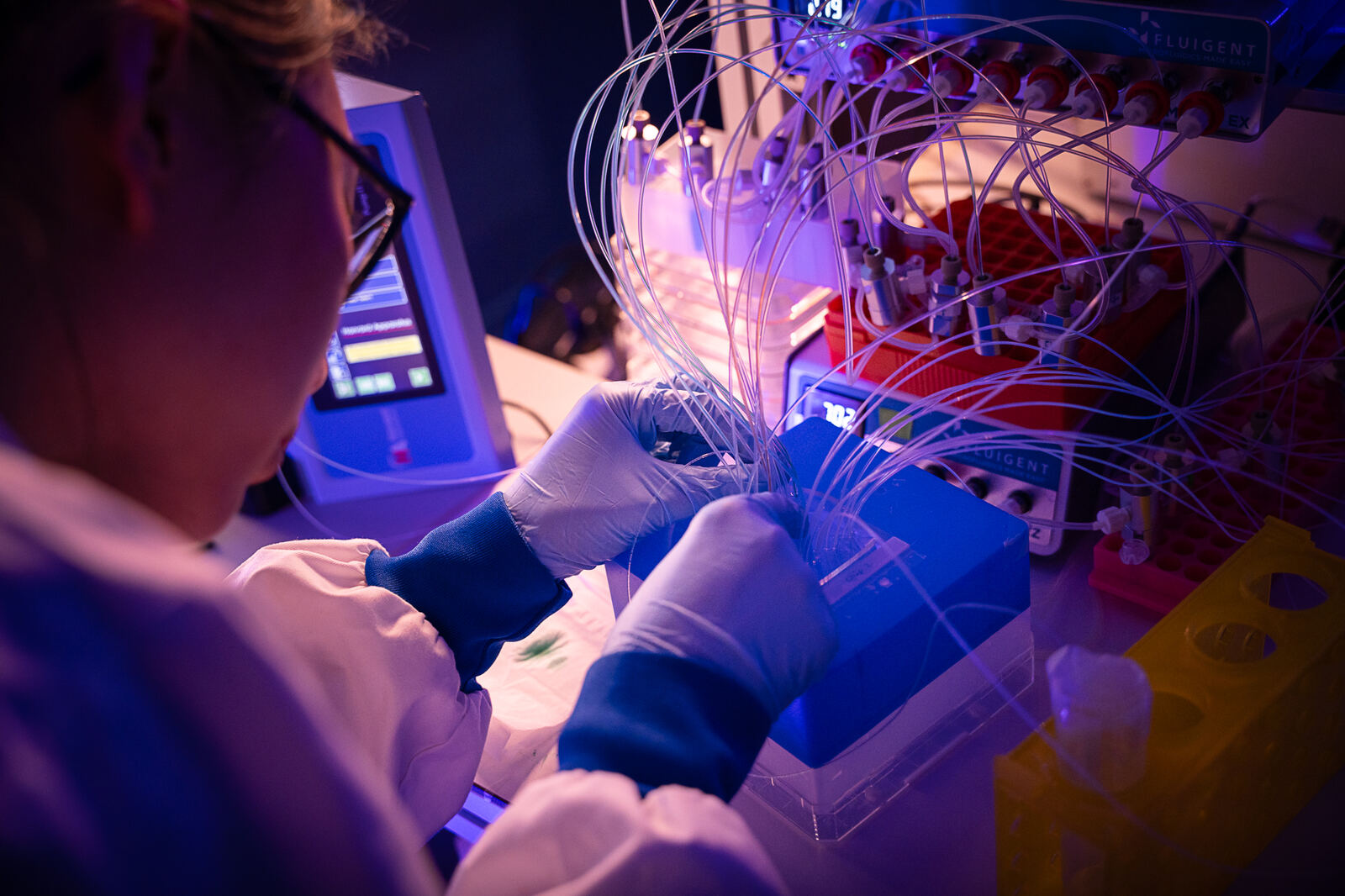
The chemical and materials industries in the Netherlands and Europe face a crucial rejuvenation phase, in which there is a sense of urgency to move from commodity to high-end material applications, such as smart coatings, biomedical materials, energy producing & storage systems and information/communication materials. The Netherlands has been a stronghold of expertise over the past decades in the named domains. However, to translate knowledge into effective applications requires an extensive optimization track which has traditionally led to limited commercial success. With the advent of machine learning and self-driving labs, this optimization process has become revolutionized with regard to speed and effectiveness, and it even compensates for a lack of knowledge on intrinsic material features.
This is Europe's agenda too. Advanced materials underpin European strategic autonomy and industrial leadership, and resilient value chains less exposed to critical-raw-material dependencies. Together with the EU's drive for advanced materials for industrial leadership, the Netherlands is positioned to lead, but only if it acts now: hesitate, and it loses its leading position and the pipeline of innovative high-tech companies its industries depend on.
DiscoveryLabNL is how the Netherlands embraces it.
From Atom to Function: designing what materials do, not only what they are.
The core argument
DiscoveryLabNL is a joint DIFFER × TU/e initiative: a shared infrastructure for autonomous materials discovery, integrating self-driving laboratories, advanced multimodal characterisation, and an AI Core to accelerate the design, synthesis, and validation of next-generation materials.
DiscoveryLabNL will shape materials research across many domains for decades to come. The Netherlands holds deep materials expertise; by joining forces nationally it strengthens that core, and where AI-first efforts have the models but not the experimental depth, DiscoveryLabNL supplies exactly that. It closes the knowledge chain from atom to function, extending a Dutch lineage in materials science into the next decade's open question: how to design what materials do, not only what they are. Foundation models have industrialised structure prediction (AlphaFold for proteins, GNoME-class models for inorganic crystals), proven on decades of shared, computable data. The experimental side of the loop remains open, and autonomous synthesis without rigorous verification has already produced contested claims. DiscoveryLabNL closes that loop for the materials that drive the next decade (soft, hybrid, hierarchical, far-from-equilibrium), where function emerges through dynamics and across scales no model can yet reach.
DiscoveryLabNL will establish breakthroughs on five key frontiers, with one architecture.
Frontier A
Information materials
Materials whose internal state stores and processes information at orders-of-magnitude lower energy than silicon-era computing.
By 2030–2035Information materials that can store data at a fraction of the energy costs now associated with data centres.
Frontier B
Designer catalysts and energy materials
Catalysts and energy materials designed for target transformations, freeing Europe from critical raw material dependencies.
By 2030–2035Smart electrodes more effective in hydrogen generation than current systems.
Frontier C
Actuating polymers and soft systems
Polymers and soft matter designed to sense, actuate, and reconfigure across length and time scales, with function emerging through molecular dynamics.
By 2030–2035Actuating materials applied in medical devices, including soft robotics for precision surgery.
Frontier D
Neuromorphic materials
Material systems that compute by their own physics — synaptic memory, in-materio learning, autonomous decision substrates beyond the von Neumann boundary.
By 2030–2035Neuromorphic materials that enable devices to operate autonomously.
Frontier E
Recyclable thermosets and circular materials
High-performance polymers and composites engineered for circularity, breaking the historical trade-off between durability and recyclability.
By 2030–2035Fully recyclable thermoset materials without loss of mechanical properties.
Horizon 2035
By 2035, DiscoveryLabNL is the Dutch interface for designing what materials do: the operational layer on which all five frontier communities run their autonomous, verifiable, explainable closed loops. In-line multimodal verification is standard practice, the AI Core's physics-grounded models are shared community infrastructure, and the Dutch materials-function genome is the foundational dataset of European materials R&D. What was demonstrated in narrow form over the past decade, DiscoveryLabNL industrialises into the federated national platform on which the next decade of discovery is built.
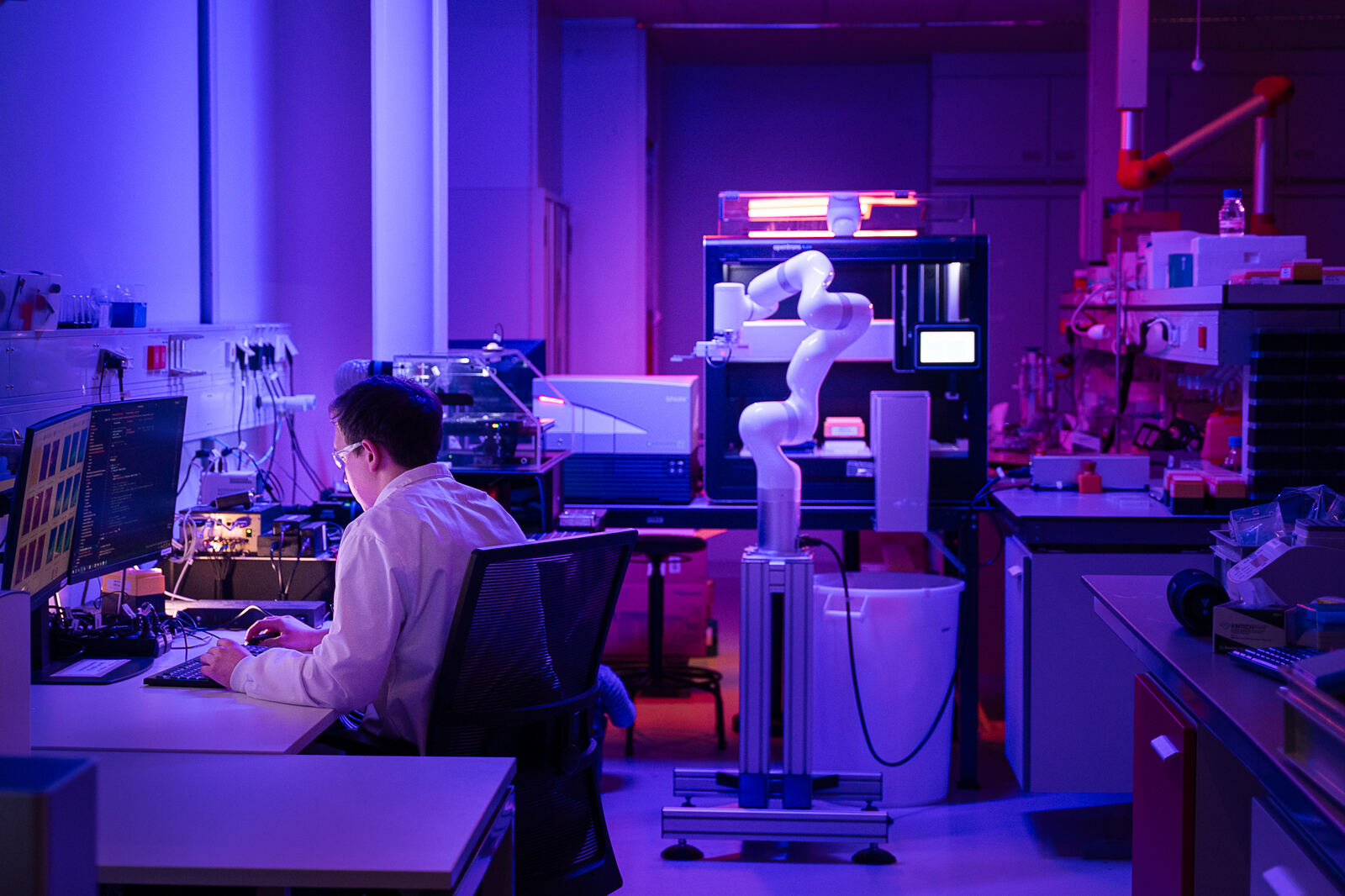
DiscoveryLabNL operates a continuous loop between exploration and interpretation. The AI Core proposes candidate designs grounded in quantum-physics-informed digital twins. Self-Driving Labs synthesise and execute at scale. Advanced Multimodal Characterisation verifies what computation cannot reach. Every turn closes back into the AI Core and lowers the cost of the next discovery.
Like a mind that works fast and slow, DiscoveryLabNL pairs fast exploration with slow, careful interpretation. Self-Driving Labs propose and execute at scale; Advanced Multimodal Characterisation verifies what computation cannot reach; the AI Core learns the design rules that close the loop. Discovery requires both speeds, working together, for results to be verifiable.
Fast and slow, working together, for verifiable discoveries.
This potential is widely recognised across the broader materials community, yet has also produced fragmentation: parallel, disconnected efforts that fall short of the systemic integration needed to realise AI's full scientific impact.
DIFFER and TU/e together hold nationally recognised SDL foundations: DIFFER's autonomous energy-materials discovery capacity underpins the LSRI Materials group pathway, and TU/e's ICMS contributes SDL platforms developed through the NWO Gravitation Programme Interactive Polymer Materials (IPM) and the National Growth Fund programme Big Chemistry, establishing a proven joint platform for this next step.
DiscoveryLabNL is the augmented lab: one infrastructure, one scientific argument, five candidate demonstrators, and the Dutch interface for the global materials genome. Every FAIR multimodal verification lowers the cost of the next discovery. The alternative is fragmented, hollow labs that do not compound.
Between 2023 and 2025, machine-learning foundation models such as DeepMind's GNoME predicted hundreds of thousands of new stable crystalline materials, and self-driving laboratories backed by large-scale funding are multiplying across every major science economy. The structure-prediction problem is functionally solved for the inorganic case.
What is missing: function prediction, verified at experimental scale.
Function emerges in the experiment. Theory cannot substitute for measurement where function emerges through dynamics and across length scales. AlphaFold solved structure prediction because biology had the Protein Data Bank. Materials function discovery has no equivalent yet. Someone has to build it.
The global SDL landscape
Global initiatives with large-scale funding are fuelling the materials revolution. The Netherlands needs to wake up, join, and lead the verifiable discoveries that shape the next decade.
Materials whose internal state stores and processes information at orders-of-magnitude lower energy than silicon-era computing.
By 2030–2035Information materials that can store data at a fraction of the energy costs now associated with data centres.
Frontier B
Designer catalysts and energy materials
Catalysts and energy materials designed for target transformations, freeing Europe from critical raw material dependencies.
By 2030–2035Smart electrodes more effective in hydrogen generation than current systems.
Frontier C
Actuating polymers and soft systems
Polymers and soft matter designed to sense, actuate, and reconfigure across length and time scales, with function emerging through molecular dynamics.
By 2030–2035Actuating materials applied in medical devices, including soft robotics for precision surgery.
Frontier D
Neuromorphic materials
Material systems that compute by their own physics — synaptic memory, in-materio learning, autonomous decision substrates beyond the von Neumann boundary.
By 2030–2035Neuromorphic materials that enable devices to operate autonomously.
Frontier E
Recyclable thermosets and circular materials
High-performance polymers and composites engineered for circularity, breaking the historical trade-off between durability and recyclability.
By 2030–2035Fully recyclable thermoset materials without loss of mechanical properties.
Horizon 2035
By 2035, DiscoveryLabNL is the Dutch interface for designing what materials do: the operational layer on which the Netherlands' information-materials, energy, actuating-soft-matter, neuromorphic, and circular-materials discovery communities run their autonomous, verifiable, explainable closed loops. Multimodal characterisation as in-line verification has become standard practice across the five frontiers, the AI Core's physics-grounded models and digital twins are shared community infrastructure, and the Dutch materials-function genome is the foundational dataset of European materials R&D. What was demonstrated in narrow form for individual material classes over the past decade, DiscoveryLabNL industrialises across materials function broadly, becoming the federated national platform on which the next decade of discovery is built.
The detailed scientific challenges and research plans for each frontier are being scoped with consortium principal investigators and will appear in the full LSRI proposal.
Three Pillars
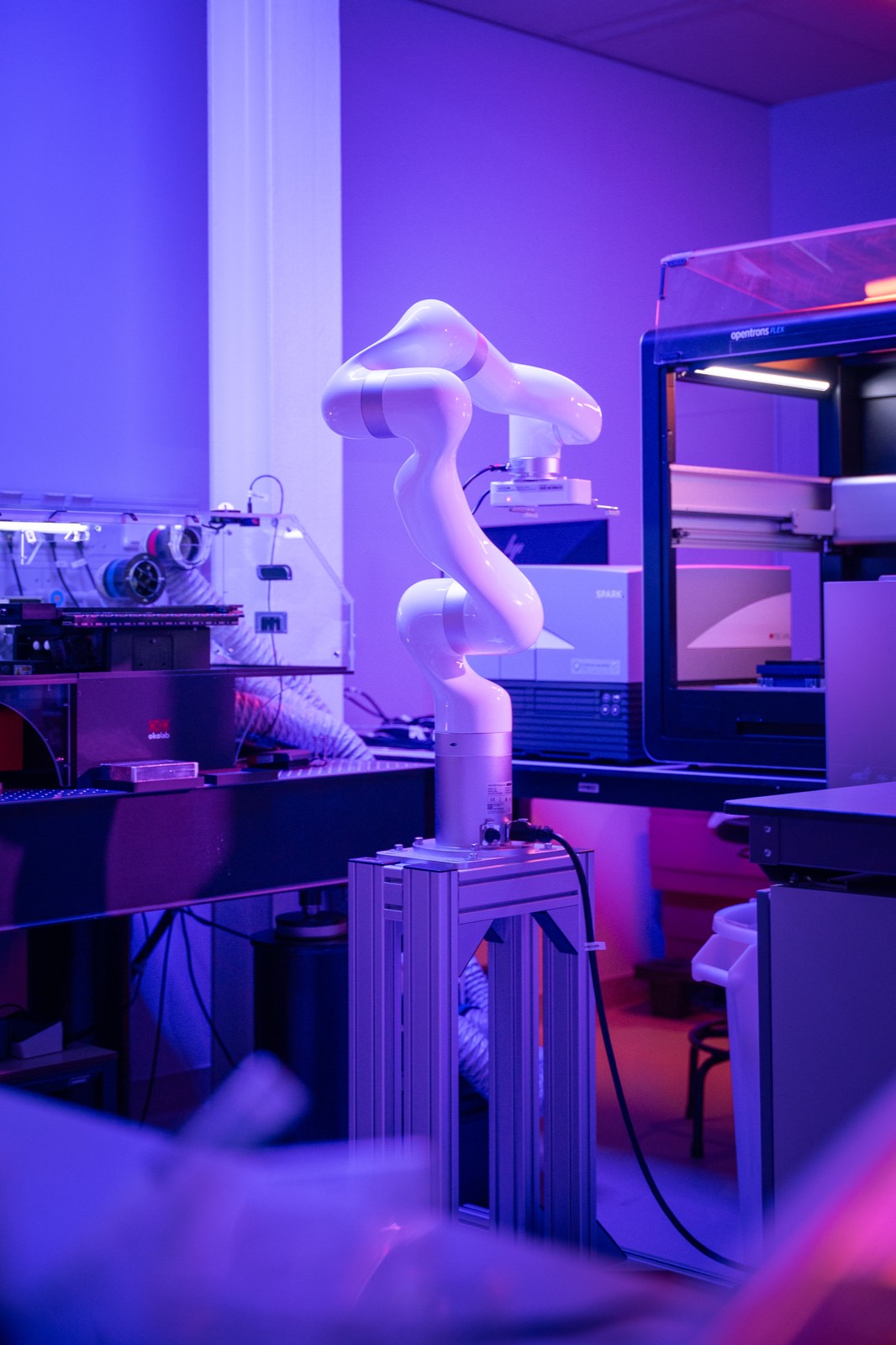
Self-Driving Laboratories
Robotic synthesis and processing platforms, automated sample handling, in-line sensing and feedback systems. AI-guided closed-loop experimentation across a hub-and-spoke network of SDL nodes.
Origin: Big Chemistry (National Growth Fund) and IPM (NWO Gravitation) platforms at ICMS. Hub-and-spoke architecture allows distributed SDL nodes across campus and national partners.
Advanced Characterisation
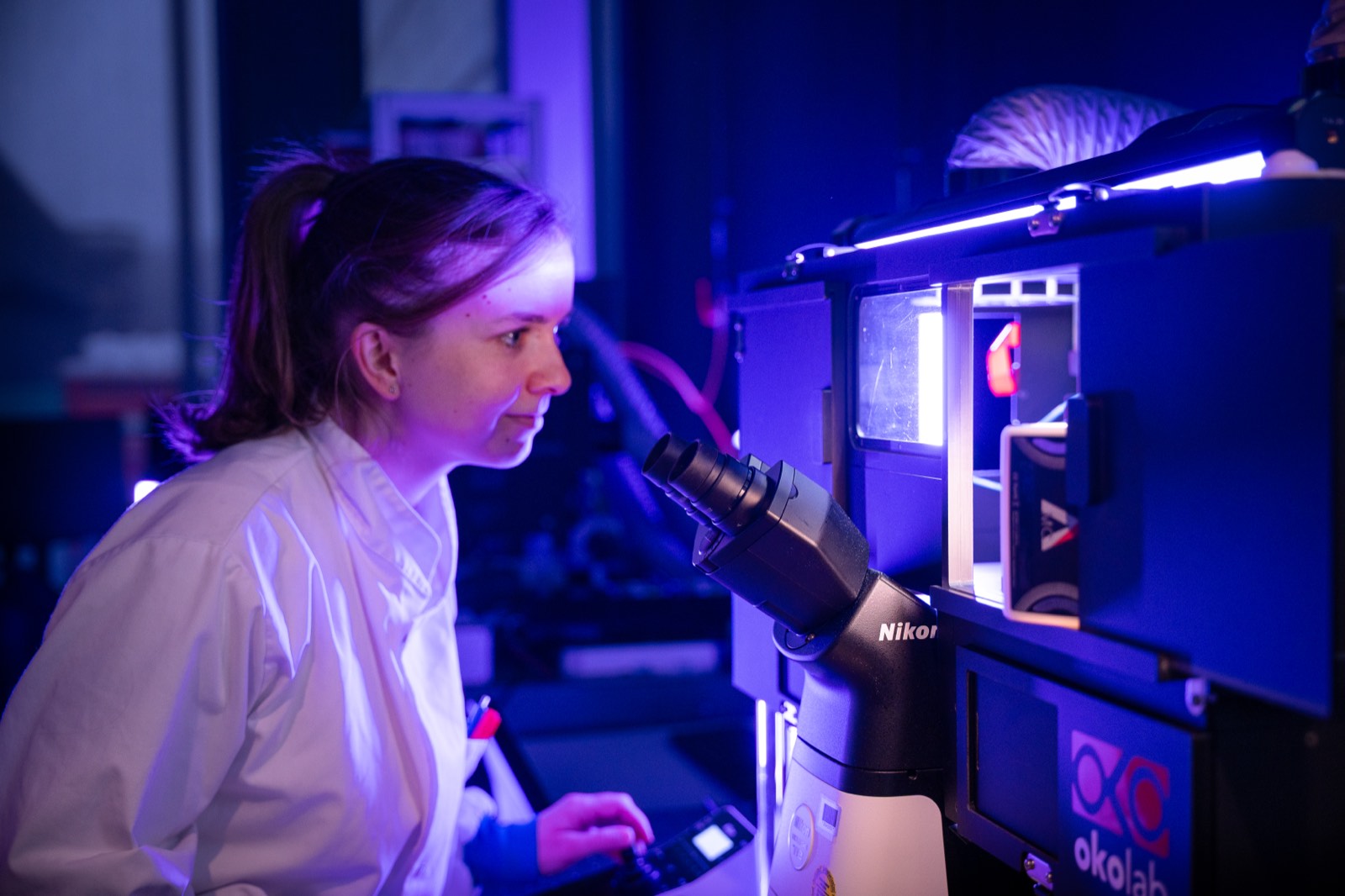
Optical, electron and X-ray microscopy combined with spectroscopic techniques. Serves as the continuous, real-time verification and integration layer of the autonomous discovery loop.
Connects to NEMI (national electron microscopy) and XNL (X-ray Netherlands). Key verification and integration layer ensuring experimental results feed back into the AI-driven discovery loop.
Operational reference:superresolution.nl, the Advanced Microscopy Facility (AMF) at ICMS.
AI Core
FAIR data backbone, curated model catalogue, dedicated AI science team — the experimental data engine and infrastructure for the next generation of materials foundation models. Federated design serving the full consortium and national partners.
Aligned with SURF and Netherlands eScience Center standards. EOSC service candidate. Serves as the digital backbone connecting all SDL nodes and characterisation facilities, and as the experimental-data source for training and grounding domain-specific materials foundation models.
Discovery Domains
Candidate research domains where autonomous, closed-loop experimentation can deliver transformative impact in advanced materials, energy, circularity, and soft matter.
Soft Matter and Biomaterials
Responsive hydrogels, self-assembling systems, and biocompatible materials for diagnostics, implants, and drug delivery.
Sustainable Energy
Accelerated design of electrolytes, electrode architectures, photocatalysts, and solar fuel systems for the energy transition.
Circular Materials
AI-guided discovery of recyclable, degradable, and bio-based polymers, composites, and inorganic systems to close the materials loop.
Molecular and Supramolecular Systems
High-throughput exploration of molecular libraries to accelerate discovery in coatings, optoelectronics, and precision functional materials.
Optoelectronic Materials
AI-driven discovery of semiconductors, photonic crystals, and light-emitting compounds. Closed-loop tuning of charge mobility, emission spectra, and quantum coherence for displays, photodetectors, and quantum-information devices.
Synthetic Biology Exploratory
Programmable living systems for on-demand biosynthesis of functional materials and therapeutic molecules.
An open consortium
An open consortium, forming now. A committed TU/e campus core, national conversations underway, international chairs invited by capability.
CommittedIn conversationOpen invitation
SDLMultimodal characterisationAI core
Click on any chair for what they bring. Coloured dots show pillar contributions.
Netherlands
Named NL partners by city.
The Global Landscape
Smart microscopy, autonomous instruments, and AI-driven spectroscopy are advancing rapidly worldwide — but groups pursue these single techniques in isolation. No major initiative integrates them into a multimodal closed loop. That requires cross-domain coordination no single group can achieve alone.
Acceleration Consortium
Canada · Can$500M
50 robots, 7 SDLs. World’s largest SDL programme. No characterisation pillar.
Korea 500 SDL
Korea · $125M+
500 labs by 2030. National scale. XRD only, no multimodal characterisation.
DIADEM
France · €85M
Synchrotron + EM + spectroscopy. Advanced but not yet integrated into SDL loops.
CAPeX
DTU, Denmark · 300M DKK (~€45M)
Synchrotron PDF in SDL loop. Battery-only, single-technique per workflow.
Big Chemistry
Netherlands · €97M
Inline techniques (tensiometry, confocal microscopy, nanoindenter). Chemistry-specific, not cross-domain.
DiscoveryLabNL
Netherlands · €30M planned
Correlated multimodal characterisation. Cross-domain. Permanent research infrastructure.
DiscoveryLabNL is led jointly by DIFFER and TU/e. DIFFER hosts the initiative as an NWO institute and anchors the LSRI Materials group pathway. TU/e's ICMS contributes established self-driving lab capacity, campus-wide materials expertise, and national characterisation and digital infrastructure connections, coordinated by Luc Brunsveld; scientific direction across TU/e is led by Jan van Hest.
Within TU/e
Available for materials research across all TU/e departments, serving as foundational infrastructure for the 'Intelligent Materials Labs' 10-year vision of the TU/e Flagship: Advanced Materials.
Across the Netherlands
Open-access platform serving the wider Dutch materials research community, supporting national research sovereignty and EU materials autonomy objectives. National consortium formation underway with leading universities and NWO research institutes, as required for LSRI national infrastructure designation.
Capital deployment, instrument procurement, AI Core ramp-up, operational launch.
🔒
Internal access only
Enter PIN to view stakeholder details
Stakeholder Momentum
Strong institutional anchors, real momentum, active engagement. The concentric rings below show stakeholder commitment levels across the national materials discovery ecosystem. Click any name for details.
Core Team
Committed
In Dialogue
Planned
Status
Role
Organisation
Notes
Pinch to zoom · tap a name for details
5 core · 18 committed · 4 in dialogue · 4 planned
Team & Contact
This briefing is shared with DiscoveryLabNL stakeholders. We welcome colleagues who wish to contribute to shaping DiscoveryLabNL, whether scientifically or organisationally. Members of the LSRI Groups Technology, Materials, and Life Sciences & Enabling Technology are particularly encouraged to reach out so we can explore alignment and collaboration opportunities together.
Core Leadership
Jan van Hest ✉Scientific Director & Lead Principal Investigator — scientific vision and delivery, institutional representation, EB & NWO communications, TU/e
Suleyman Er ✉Scientific Lead — LSRI Materials group pathway, autonomous energy-materials discovery, DIFFER
Luc Brunsveld ✉Scientific Lead — ICMS scientific direction, TU/e
Yuyang Wang ✉Initiative Lead — programme operations, consortium formation, NWO positioning, TU/e